Tangerine Reverie
2026 | Group Exhibition | Bangdo, Seoul, Republic of Korea
Exhibition: Aug 4 – Aug 13, 2026
Venue: Bangdo (33-1, Yeongjung-ro 14-gil, Yeongdeungpo-gu, Seoul)
Artists: Jina Shin, Bang Seonu, Hyeran Jang
Yeongdeungpo, Seoul. An August summer. In an old house¹ through which countless bodies have passed, and where they may still linger…
Tangerine Reverie begins with the red memories that live within us — tangerine-hued, deep vermilion. Yes, each of us carries red memories: gazing at the dim glow of dawn, losing ourselves in thought before a blazing campfire, watching heat haze shimmer above scorching ground on holiday, breathing in the acrid smoke that filled the house after a pot was left to burn. The memories that come with tangerine have sound; they give off heat; they carry a smell. The exhibition gathers tangerine-colored reveries that have arisen here and there, seeking to draw out the red memories within us.
Fire makes us feel the air — with our eyes, our noses, our skin. And where fire has passed, ash remains. In combustion, where fire, ash, and hazy smoke intersect, things burn: buildings, trees, pesticides, flowers, benches, grass, asphalt, sand, frogs, earthworms, ants, microbes, people… Ash mingles with the particles of the air. Hazy smoke passes through our noses and pierces deep into our lungs. Speaking of what it means to be born and to exist, the philosopher Emanuele Coccia says that we "recycle a piece of flesh that was already alive." We are constantly passing flesh on to one another. That flesh is very old, and it flows into us unexpectedly.
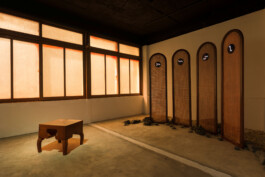
Through fire and ash, and from a perspective at once molecular and molar, Tangerine Reverie seeks to sense the air and breath that act on our bodies most intimately yet so often go unnoticed, along with the environment that surrounds us. In this space, try to sense whose voice can be heard, what is giving off a scent, and the something that brushes against your skin. By chance, and by necessity, the tangerine-hued red memories each of us carries will seep into the walls of this space, settle into the works, and drift through the air.
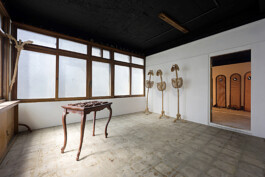
Jina Shin pays attention to the occult forces and beings that haunt the present, and makes bodies (/objects) in which those forces and beings accumulate. In particular, she does not dismiss the superstitious entities that are so often written off as futile or pushed to the margins. Through sculpture, video, and performance, the artist captures the shapes of individual desire and lack that come into contact with the occult and the superstitious.
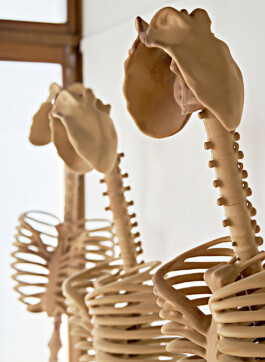
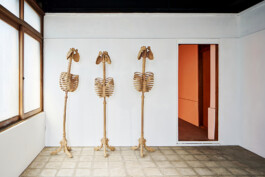
Spine Choir is a sculpture that takes the form of human ribs, spines, and pelvic bones. Stripped of flesh, some of the bone fragments roll across the floor and evoke the abject, yet a few, ironically, stand upright as if they had regained life — much like the choir the work's title calls to mind. What, then, does it mean to be 'alive' here? The ribs, meanwhile, are open like a chipped bowl, and rising incense smoke sweeps through every crevice of the bones, circulating through the gaps. Having become a 'passage' for the smoke-object, the body turns into a dwelling for multiple beings, and before the circulating smoke, the act of dividing life from death loses its meaning.
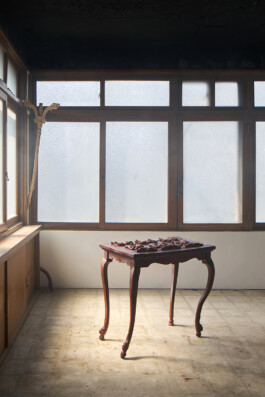
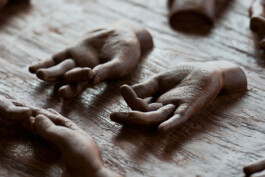
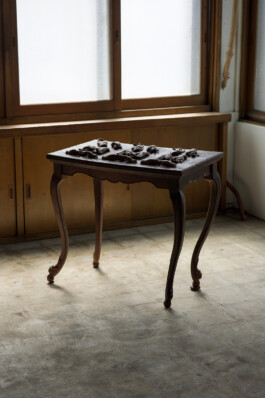
In Buddhism and Hinduism, the mudra gestures that appear in Mudra as Petition and Mudra as Hunger are meant to please the gods, but these works veer away from that purpose. For Shin, the mudra is closer to a spiritual practice of sensing, summoning, and remembering invisible beings. In other words, the countless hands clinging to the table and glitching across the video are closer to hidden beings crying out, "We are here!"
Spine Choir
3D-printed plastic, acrylic, incense, fog machine | 175×35×45 cm | 2026
Mudra as Petition
Wood, acrylic, incense, fog machine | 80×45×74 cm | 2026
The Mechanics of Prayer
UV print on wood | 40×41×43 cm | 2026
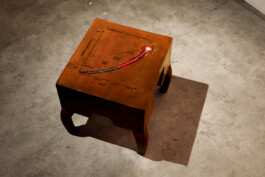
Mudra as Hunger
Four-channel video installation, color, sound, wood | Dimensions variable | 2026
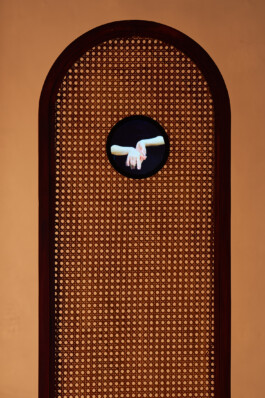
Tangerine Reverie
2026 | Group Exhibition | Bangdo, Seoul, Republic of Korea
Exhibition: Aug 4 – Aug 13, 2026
Venue: Bangdo (33-1, Yeongjung-ro 14-gil, Yeongdeungpo-gu, Seoul)
Artists: Jina Shin, Bang Seonu, Hyeran Jang
Yeongdeungpo, Seoul. An August summer. In an old house¹ through which countless bodies have passed, and where they may still linger…
Tangerine Reverie begins with the red memories that live within us — tangerine-hued, deep vermilion. Yes, each of us carries red memories: gazing at the dim glow of dawn, losing ourselves in thought before a blazing campfire, watching heat haze shimmer above scorching ground on holiday, breathing in the acrid smoke that filled the house after a pot was left to burn. The memories that come with tangerine have sound; they give off heat; they carry a smell. The exhibition gathers tangerine-colored reveries that have arisen here and there, seeking to draw out the red memories within us.
Fire makes us feel the air — with our eyes, our noses, our skin. And where fire has passed, ash remains. In combustion, where fire, ash, and hazy smoke intersect, things burn: buildings, trees, pesticides, flowers, benches, grass, asphalt, sand, frogs, earthworms, ants, microbes, people… Ash mingles with the particles of the air. Hazy smoke passes through our noses and pierces deep into our lungs. Speaking of what it means to be born and to exist, the philosopher Emanuele Coccia says that we "recycle a piece of flesh that was already alive." We are constantly passing flesh on to one another. That flesh is very old, and it flows into us unexpectedly.
Through fire and ash, and from a perspective at once molecular and molar, Tangerine Reverie seeks to sense the air and breath that act on our bodies most intimately yet so often go unnoticed, along with the environment that surrounds us. In this space, try to sense whose voice can be heard, what is giving off a scent, and the something that brushes against your skin. By chance, and by necessity, the tangerine-hued red memories each of us carries will seep into the walls of this space, settle into the works, and drift through the air.
Jina Shin pays attention to the occult forces and beings that haunt the present, and makes bodies (/objects) in which those forces and beings accumulate. In particular, she does not dismiss the superstitious entities that are so often written off as futile or pushed to the margins. Through sculpture, video, and performance, the artist captures the shapes of individual desire and lack that come into contact with the occult and the superstitious.
Spine Choir is a sculpture that takes the form of human ribs, spines, and pelvic bones. Stripped of flesh, some of the bone fragments roll across the floor and evoke the abject, yet a few, ironically, stand upright as if they had regained life — much like the choir the work's title calls to mind. What, then, does it mean to be 'alive' here? The ribs, meanwhile, are open like a chipped bowl, and rising incense smoke sweeps through every crevice of the bones, circulating through the gaps. Having become a 'passage' for the smoke-object, the body turns into a dwelling for multiple beings, and before the circulating smoke, the act of dividing life from death loses its meaning.
In Buddhism and Hinduism, the mudra gestures that appear in Mudra as Petition and Mudra as Hunger are meant to please the gods, but these works veer away from that purpose. For Shin, the mudra is closer to a spiritual practice of sensing, summoning, and remembering invisible beings. In other words, the countless hands clinging to the table and glitching across the video are closer to hidden beings crying out, "We are here!"
Spine Choir
3D-printed plastic, acrylic, incense, fog machine | 175×35×45 cm | 2026
Mudra as Petition
Wood, acrylic, incense, fog machine | 80×45×74 cm | 2026
The Mechanics of Prayer
UV print on wood | 40×41×43 cm | 2026
Mudra as Hunger
Four-channel video installation, color, sound, wood | Dimensions variable | 2026